
Biocompatibilidad - EN ISO 10993ff
compra la norma en AENOR
Todas las partes de un producto sanitario que entran en contacto con el paciente o el operador deben ser biocompatibles, es decir, seguro biológicamente contemplándose en la norma la protección de los seres humanos frente a los riesgos biológicos potenciales derivados de la utilización de productos sanitarios.
La norma de referencia es la EN ISO 10993-1 que incluye referencia a diversas partes de la misma que especifican los requisitos adicionales
| ISO 10993-1:2009 Biological evaluation of medical devices — Part 1: Evaluation and testing within a risk management process |
| ISO 10993-1:2009/Cor 1:2010 |
| ISO 10993-2:2006 Biological evaluation of medical devices — Part 2: Animal welfare requirements |
| ISO 10993-3:2014 Biological evaluation of medical devices — Part 3: Tests for genotoxicity, carcinogenicity and reproductive toxicity |
| ISO 10993-4:2002 Biological evaluation of medical devices — Part 4: Selection of tests for interactions with blood |
| ISO 10993-4:2002/Amd 1:2006 |
| ISO 10993-5:2009 Biological evaluation of medical devices — Part 5: Tests for in vitro cytotoxicity |
| ISO 10993-6:2007 Biological evaluation of medical devices — Part 6: Tests for local effects after implantation |
| ISO 10993-7:2008 Biological evaluation of medical devices — Part 7: Ethylene oxide sterilization residuals |
| ISO 10993-7:2008/Cor 1:2009 |
| ISO 10993-9:2009 Biological evaluation of medical devices — Part 9: Framework for identification and quantification of potential degradation products |
| ISO 10993-10:2010 Biological evaluation of medical devices — Part 10: Tests for irritation and skin sensitization |
| ISO 10993-11:2006 Biological evaluation of medical devices — Part 11: Tests for systemic toxicity |
| ISO 10993-12:2012 Biological evaluation of medical devices — Part 12: Sample preparation and reference materials |
| ISO 10993-13:2010 Biological evaluation of medical devices — Part 13: Identification and quantification of degradation products from polymeric medical devices |
| ISO 10993-14:2001 Biological evaluation of medical devices — Part 14: Identification and quantification of degradation products from ceramics |
| ISO 10993-15:2000 Biological evaluation of medical devices — Part 15: Identification and quantification of degradation products from metals and alloys |
| ISO 10993-16:2010 Biological evaluation of medical devices — Part 16: Toxicokinetic study design for degradation products and leachables |
| ISO 10993-17:2002 Biological evaluation of medical devices — Part 17: Establishment of allowable limits for leachable substances |
| ISO 10993-18:2005 Biological evaluation of medical devices — Part 18: Chemical characterization of materials |
| ISO/TS 10993-19:2006 Biological evaluation of medical devices — Part 19: Physico-chemical, morphological and topographical characterization of materials |
| ISO/TS 10993-20:2006 Biological evaluation of medical devices — Part 20: Principles and methods for immunotoxicology testing of medical devices |
| ISO/TR 10993-33:2015 Biological evaluation of medical devices — Part 33: Guidance on tests to evaluate genotoxicity — Supplement to ISO 10993-3 |
| ISO/TR 15499:2012 Biological evaluation of medical devices — Guidance on the conduct of biological evaluation within a risk management process |
| ISO/TR 37137:2014 Cardiovascular biological evaluation of medical devices — Guidance for absorbable implants |
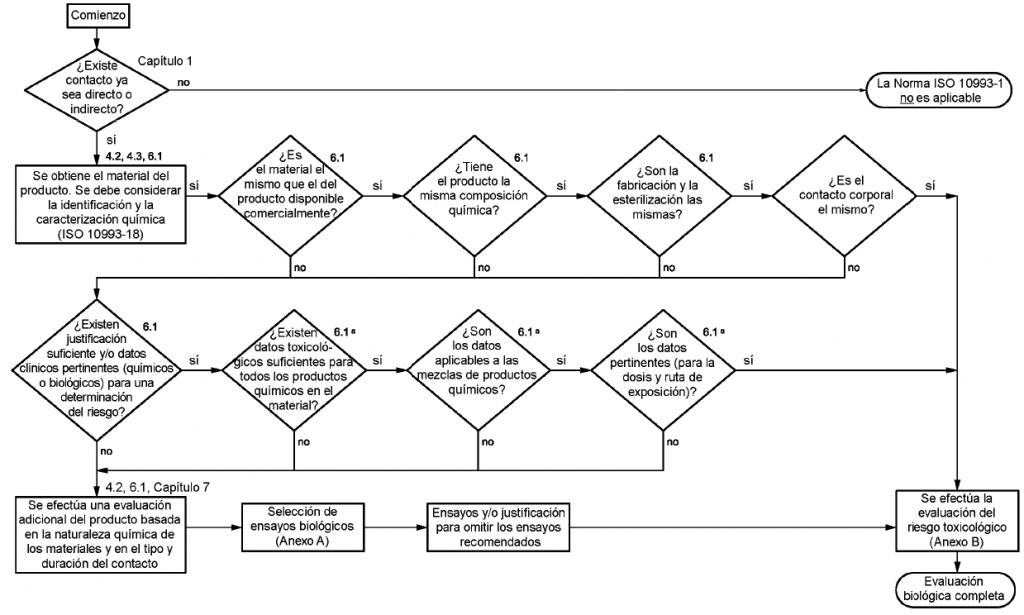
Nótese que debe analizarse mediante gestión de riesgos.
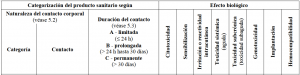
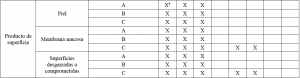
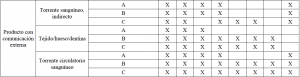
Los ensayos a realizar según la naturaleza del contacto y su duración viene reflejan en la tabla siguiente:

Las normas de esta familia son: